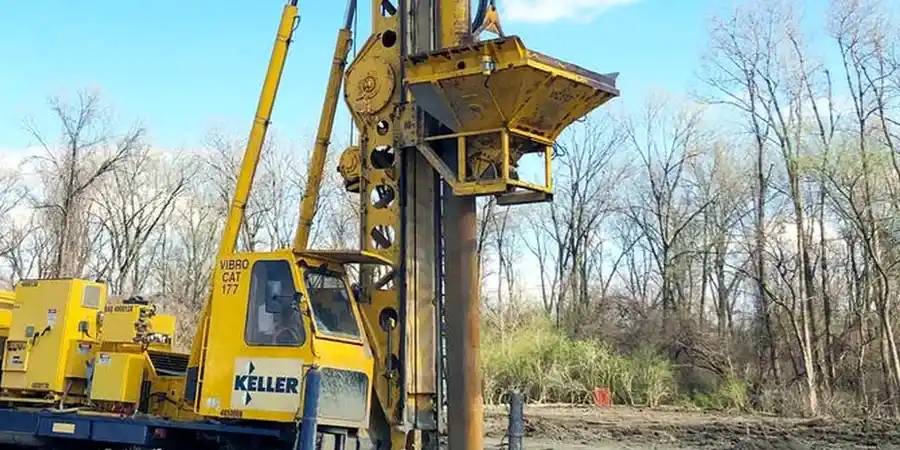
Much of the industrial corridor east of downtown Billings sits on Holocene alluvial terraces deposited by the Yellowstone River—loose sands and gravels that can exceed 40 feet in thickness before hitting competent bedrock. When a planned warehouse expansion near the South Billings Boulevard interchange showed SPT N-values below 10 in the upper 20 feet, the structural engineer flagged differential settlement as a hard constraint. That is precisely the scenario where vibrocompaction design becomes the most cost-effective ground improvement strategy, far more practical than over-excavation or piling through clean granular profiles. Our approach combines a CPT test campaign to map tip resistance continuously across the site, followed by a compaction trial grid to calibrate vibrator frequency, spacing and duration against the target relative density—typically 70% or higher for commercial structures under IBC Chapter 18.
We target a post-treatment relative density of 70–85% under IBC Chapter 18, verified by CPT before and after each compaction pass.