GEOTECHNICAL ENGINEERING
BILLINGS
HomeGround improvementStone column design

Stone Column Design in Billings: Ground Improvement for Weak Soils

Evidence-based design. Reliable delivery.

LEARN MORE

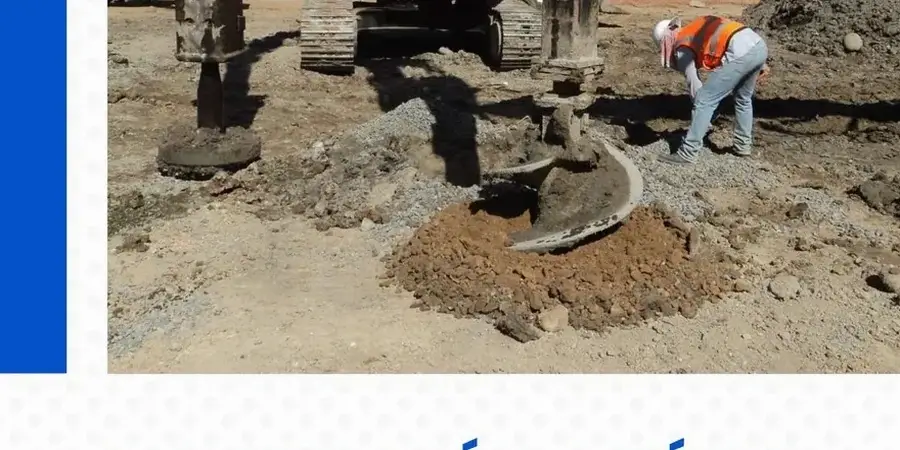
A vibroflot crawler crane positions its extended lead over a marked grid point on a Billings site east of the airport, feeding crushed stone into a cylindrical probe that compacts the subsurface in controlled lifts. The operator monitors amperage draw and stone consumption in real time, building a stiff drainage column through the soft, flood-deposited silts that underlie much of the Yellowstone River corridor. In Billings, where the average annual precipitation hovers around 13.8 inches yet the water table sits surprisingly shallow on terrace deposits, in-situ permeability testing often guides the spacing design to ensure excess pore pressures dissipate quickly during seismic loading. We pair the vibro-replacement installation with a CPT test beforehand to map tip resistance and sleeve friction continuously, confirming that the native clayey matrix will carry out adequate lateral confinement to the stone columns under the design bearing pressure.

A well-designed stone column grid transforms liquefiable Yellowstone alluvium into a drained, densified composite that can support 6,000 psf bearing pressure.
Our service areas

Our approach and scope

In Billings, we frequently observe that the alluvial clays beneath proposed warehouse slabs exhibit undrained shear strengths below 500 psf, a condition where unreinforced footings would punch through. The stone column design shifts the failure mechanism from bearing to bulging, relying on radial confinement from the surrounding soil to mobilize composite stiffness. A key parameter we verify through ASTM D1586 blow counts is the improvement ratio—typically targeting a factor of 2 to 3 for the composite friction angle, moving from roughly 28° in the native soft clay to over 38° in the treated mass. Column diameters range from 30 to 42 inches depending on the vibroflot's amperage capacity and the gravel gradation specified under ASTM D2487; we favor clean, angular crushed stone with a friction angle above 40° to maximize interlock. When the project sits within the 100-year floodplain mapped by the Yellowstone County Floodplain Administrator, the drainage function becomes as critical as the load-bearing function, and we integrate the column grid with a mat foundation to distribute structural loads evenly while allowing groundwater to migrate upward through the gravel chimneys during spring runoff events.
Stone Column Design in Billings: Ground Improvement for Weak Soils
Technical reference — Billings

Local geotechnical context

Billings’s expansion south of the Rimrocks during the 1970s and 1980s pushed commercial development onto the alluvial fans and floodplain deposits that had previously been irrigated farmland. Those soils—interbedded silts, clays, and loose sands deposited by the meandering Yellowstone River—were never intended to carry heavy structural loads. The most dangerous assumption a design team can make is that a uniform grid spacing will work everywhere on a Billings site; we have measured SPT values varying from 3 to 18 within a single building footprint due to buried paleochannels. Skipping a site-specific liquefaction analysis under ASCE 7-22 Chapter 21 for a site with a design earthquake magnitude of 6.5 or higher leaves a stone column design blind to the pore pressure buildup that the columns are specifically meant to relieve. A column that functions as a drain must have a continuous gravel path to a free-draining blanket at the surface—if that blanket gets paved over without a venting detail, the system fails exactly when it is needed most.

Need a geotechnical assessment?

Reply within 24h.

Email: contact@geotechnicalengineering.biz

Relevant standards

ASCE 7-22 (Minimum Design Loads for Buildings and Other Structures), ASTM D1586 (Standard Test Method for Standard Penetration Test), ASTM D2487 (Standard Practice for Classification of Soils for Engineering Purposes), IBC 2021 (International Building Code, Chapter 18)

Technical data

ParameterTypical value
Typical Column Diameter30 to 42 inches
Area Replacement Ratio10% to 35%
Composite Friction Angle (treated)38° to 42°
Target SPT N-value (post-treatment)15 to 25 blows/ft
Design Bearing Pressure4,000 to 8,000 psf
Settlement Reduction Factor2 to 4
Gravel Friction Angle (ASTM D2487)> 40°
Applicable Depth Range10 to 60 feet

Q&A

What subsurface conditions in Billings make stone columns the right choice over rigid inclusions or piles?

Stone columns excel in the soft alluvial clays and loose silty sands common along the Yellowstone River floodplain in Billings. When the undrained shear strength of the native soil falls between 300 and 700 psf, vibro-replacement provides both load-bearing improvement and drainage. Rigid inclusions become more economical when strengths drop below 200 psf, while driven piles are typically reserved for sites where settlement tolerances are extremely tight or where the column would lack lateral confinement. Our recommendation always follows a side-by-side comparison based on CPT data from the specific Billings site.

How do you verify that installed stone columns meet the design specifications?

We use a three-tier verification approach. During installation, we record amperage draw and stone volume per lift on the vibroflot data logger. Post-installation, we run SPT or CPT soundings at centroid locations between columns to confirm the target improvement in penetration resistance. For critical structures, we perform a full-scale modulus load test on a single column and a zone load test on a group of four, measuring settlement under sustained load and comparing the load-deflection curve to the design model.

What is the typical cost range for a stone column design package in Billings?

The design package for a stone column ground improvement project in Billings generally ranges from US$1,530 to US$5,970, depending on the size of the treatment area, the complexity of the subsurface profile, and the number of load tests required. A small commercial lot with uniform soils sits at the lower end, while a multi-acre industrial site with highly variable paleochannel deposits and a full-scale zone load test program falls at the upper end.

How do you account for the shallow groundwater table in Billings during stone column installation and design?

The shallow groundwater in the Yellowstone alluvium—often encountered within 6 to 10 feet of grade in Billings—is actually beneficial for vibro-replacement because it reduces side friction on the vibroflot and helps the stone feed smoothly. In design, we check that the crushed stone gradation has less than 5% fines passing the #200 sieve so that the column remains free-draining. We also specify a working platform of clean granular fill above the water table to support the crawler crane and prevent mud from contaminating the stone at the column head.

Location and service area

We serve projects in Billings and surrounding areas.

View larger map