GEOTECHNICAL ENGINEERING
BILLINGS
HomeLaboratoryGrain size analysis (sieve + hydrometer)

Grain Size Analysis for Foundation Design in Billings

Evidence-based design. Reliable delivery.

LEARN MORE

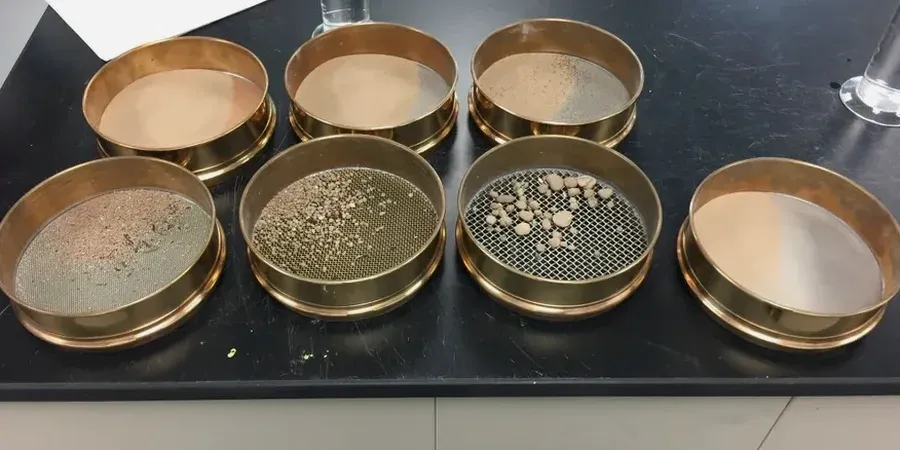
Billings sits at 3,123 feet, wedged between sandstone rimrocks and the Yellowstone River floodplain. That elevation shift matters. A site on the Rims deals with weathered sandstone residuum. A site down in the valley hits river terrace gravels mixed with fat clays. The 2022 Stillwater River flood reminded every engineer in town: grain size distribution controls everything. Permeability. Frost susceptibility. Compaction effort. We run the full ASTM D422 curve—sieve stack plus hydrometer—so your gradation data isn't a guess. Our lab processes samples from Lockwood to the West End, delivering USCS classifications that feed directly into your bearing capacity calcs and drainage design. For deeper profiling, we often pair this with SPT drilling to correlate gradation shifts with blow count changes at depth.

A missing hydrometer on a clay site in Billings can undersize the frost heave risk by a factor of three. The fines dictate the design.
Our service areas

Our approach and scope

Compare two Billings sites and you'll see the problem. A lot along Shiloh Road might be well-graded gravel with less than 5% fines—great for compaction, terrible for water retention. Head north toward the Heights, and you hit lean clays with 60% passing the #200 sieve. Same city, opposite foundation behavior. Our procedure splits the sample at the #4 and #200 sieves. Coarse fraction goes through the full stack: 3/4-inch down to #100. Fine fraction gets the hydrometer bath with sodium hexametaphosphate, reading density at 40 seconds, 2 minutes, 5, 15, 30, 60, and 24 hours. We compute D10, D30, D60. Then uniformity coefficient and coefficient of curvature. Every number cross-checked against the Atterberg limits data when plasticity is in play. The report includes the full semi-log plot, not just a summary table, because the shape of the curve tells you more than two numbers ever could.
Grain Size Analysis for Foundation Design in Billings
Technical reference — Billings

Local geotechnical context

The most common mistake we see on Billings projects? Running only a wash #200 and calling it a gradation. That gives you fines content but zero information about the silt-versus-clay split. In the frost-susceptible silts common south of the Yellowstone, that's a design failure waiting to happen. AASHTO and IBC frost protection depth is 42 inches here. If you misclassify an ML as a CL because you skipped the hydrometer, your subgrade prep and footing depth will be wrong. Another frequent error: not correcting hydrometer readings for temperature and meniscus. Our lab runs at 20°C with blank controls every batch. When the curve shows a gap-graded structure—common in the colluvial deposits near the base of the Rims—we flag it immediately. That material can settle differentially under cyclic loading. For sites with questionable fines, we recommend correlating the gradation with an in-situ permeability test to verify the drainage assumptions built into the design.

Need a geotechnical assessment?

Reply within 24h.

Email: contact@geotechnicalengineering.biz

Relevant standards

ASTM D422 – Standard Test Method for Particle-Size Analysis of Soils, ASTM D6913 – Sieve Analysis of Fine and Coarse Aggregates, ASTM D7928 – Hydrometer Analysis (sedimentation), ASTM D2487 – USCS Classification, IBC 2021 – Frost depth and foundation requirements

Technical data

ParameterTypical value
Test standardASTM D422 / D6913 / D7928
Sample mass (coarse-grained)500 g minimum (sieve analysis)
Sample mass (fine-grained)200 g dry (hydrometer analysis)
Sieve range3 in to #200 (75 mm to 75 µm)
Hydrometer type152H, calibrated at 20°C
DispersantSodium hexametaphosphate (40 g/L solution)
Coefficients reportedCu, Cc, D10, D30, D50, D60
USCS classification perASTM D2487

Q&A

How much does a full grain size analysis (sieve + hydrometer) cost in Billings?

For a standard ASTM D422 test with full sieve stack and hydrometer sedimentation, the cost ranges from US$110 to US$180 per sample depending on the number of samples in the batch and whether Atterberg limits are included in the same request.

How long does the hydrometer analysis take?

Minimum 24 hours for the sedimentation readings alone. The full report—including sieve analysis, hydrometer, curve plotting, and USCS classification—is typically delivered within 3 to 4 business days from sample receipt. We can expedite to 48 hours for tight project schedules.

Can you classify the soil for compaction specification from this test?

Yes. The gradation curve and USCS group symbol tell you whether the material is well-graded gravel (GW), poorly-graded sand (SP), silty sand (SM), or lean clay (CL). That classification directly determines the appropriate compaction method, moisture conditioning requirements, and density targets per your project spec.

What sample size do you need for a combined sieve and hydrometer test?

We need roughly 500 grams of material passing the #4 sieve for the hydrometer. For the full sieve stack, the total sample depends on maximum particle size: about 500 g for fine sands, up to 5 kg for gravelly soils with particles up to 3 inches. We can advise on sample splitting if you are pulling from a larger bulk sample.

Does the grain size analysis identify expansive clays?

Grain size alone only tells you the clay fraction percentage—the minus 2-micron content. To confirm expansive behavior, you need the Atterberg limits (liquid limit and plasticity index) and ideally a swell test. We offer all three as a combined package when expansive soils are a concern in the Billings area.

Location and service area

We serve projects in Billings and surrounding areas.

View larger map