GEOTECHNICAL ENGINEERING
BILLINGS
HomeSeismicBase isolation seismic design

Base Isolation Seismic Design in Billings: Protecting Structures Against Montana Ground Motion

Evidence-based design. Reliable delivery.

LEARN MORE

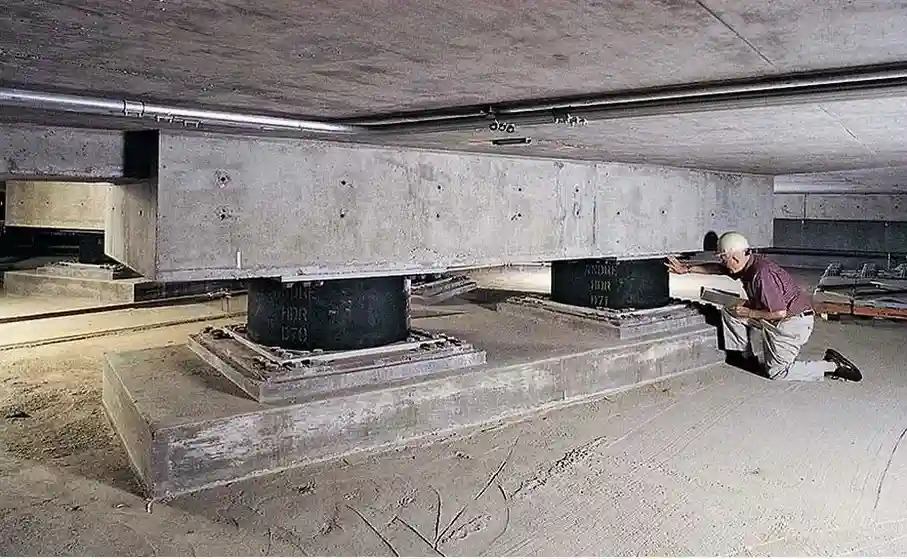
In Billings, the sandstone cliffs and the Yellowstone River define the landscape, but the real threats often lie beneath. The 1935 Helena earthquake, felt strongly here, reminded everyone that Montana is not seismically quiet. When a hospital or data center goes up on the south side near the Rimrocks, standard fixed-base construction leaves too much to chance. We approach base isolation seismic design as a direct engineering response to the Intermountain Seismic Belt. The goal is straightforward: decouple the structure from ground motion. Our team applies ASCE 7 Chapter 17 criteria from the earliest schematic phase, ensuring the isolation system period stays above 2.5 seconds. On a recent project near the Billings Clinic, integrating lead-rubber bearings required us to first verify subsurface conditions with test pits to confirm bearing capacity before isolator placement.

A well-tuned isolation system reduces spectral acceleration demands on the superstructure by 60 to 80 percent compared to a fixed-base design in Billings.
Our service areas

Our approach and scope

Billings sits on a shallow bedrock profile in many areas, which transmits high-frequency seismic energy more efficiently than deep soil basins. That changes the isolation strategy. The isolators must handle short-period acceleration spikes that would otherwise rattle non-structural components loose. Our design process models the upper 100 feet of stratigraphy, often sandstone over shale, to predict spectral acceleration at periods of 0.2 and 1.0 seconds. We pair these site-specific hazard curves with nonlinear time-history analysis.

Key elements we control include the effective stiffness of the isolation layer, damping ratios between 15 and 25 percent, and displacement capacity under the Maximum Considered Earthquake. For structures on alluvial deposits near the river, we often recommend supplementing the isolation plane with a seismic microzonation study to map lateral variability before finalizing bearing dimensions. The isolator testing protocol follows the manufacturing quality control outlined in ASCE 7 Section 17.8, with prototype tests run to three times the design displacement.
Base Isolation Seismic Design in Billings: Protecting Structures Against Montana Ground Motion
Technical reference — Billings

Local geotechnical context

ASCE 7-22 Section 17.2.4 mandates that base-isolated structures in Seismic Design Category D must demonstrate reliable behavior under MCE shaking. Billings falls into this category. Skipping the peer review process or underestimating the moat wall clearance puts the entire investment at risk. If an isolator hits the retaining wall during the design earthquake, the superstructure reverts to fixed-base behavior and experiences forces it was never designed to resist. The residual displacement after a large event also matters: a building shifted 8 inches off-center requires expensive realignment. We mitigate this with moat covers that articulate under movement and with uplift restraints sized for the maximum vertical acceleration. Fire protection systems crossing the isolation plane demand flexible couplings tested to the same displacement demand. These details separate a resilient building from a liability.

Need a geotechnical assessment?

Reply within 24h.

Email: contact@geotechnicalengineering.biz

Relevant standards

ASCE/SEI 7-22 Chapter 17: Seismic Isolation, IBC 2021 Section 1705: Required Verification and Inspection, ASTM D4014: Standard Specification for Plain and Steel-Laminated Elastomeric Bearings for Bridges, ASCE/SEI 41-23: Seismic Evaluation and Retrofit of Existing Buildings

Technical data

ParameterTypical value
Design spectral acceleration at 1.0s (SD1)0.12g to 0.18g (site class C/D)
Maximum Considered Earthquake (MCE) displacement14 to 22 inches typical
Effective damping ratio15% to 25%
Isolator type commonly specifiedLead-rubber bearings (LRB) per ASCE 7-22
Peer review requirementASCE 7 Section 17.11 independent review
Isolation system period (target)2.5 to 3.5 seconds
Applicable IBC editionIBC 2021 incorporating ASCE 7-22

Q&A

What is the typical cost range for a base isolation seismic design package in Billings?

For a medium-sized essential facility in Billings, the structural engineering fees for base isolation design typically range from US$3,680 to US$7,960, depending on the building footprint, number of stories, and complexity of the isolation plane. This covers the nonlinear analysis model, isolator specification, peer review coordination, and construction administration support. A precise fee proposal requires reviewing the architectural floor plans and the geotechnical report.

How does the shallow bedrock in parts of Billings affect isolator performance?

Shallow bedrock amplifies high-frequency ground motion, which can excite non-structural components and stiff equipment. We address this by selecting isolators with sufficient damping and by modeling floor response spectra at each level. The isolation system must still be flexible enough to shift the fundamental period above 2.5 seconds, but the near-surface rock requires careful attention to vertical acceleration and uplift potential.

What level of peer review is required for an isolated structure?

ASCE 7-22 Section 17.11 requires an independent peer review for any base-isolated structure in Seismic Design Category C or higher, which includes Billings. The reviewer must examine the ground motion selection, the isolator properties, the nonlinear analysis results, and the stability of the isolation system under MCE displacements. We coordinate this review as part of our service, compiling the required calculation package and responding to reviewer comments.

Can an existing building be retrofitted with base isolation?

Yes, but the process is more invasive than new construction. The existing columns must be cut at the isolation plane, temporary supports installed, and isolators inserted. We typically apply this to heritage structures or critical infrastructure. The feasibility study starts with a structural condition assessment and a cost comparison against a fixed-base retrofit designed to ASCE 41-23.

Location and service area

We serve projects in Billings and surrounding areas.

View larger map